
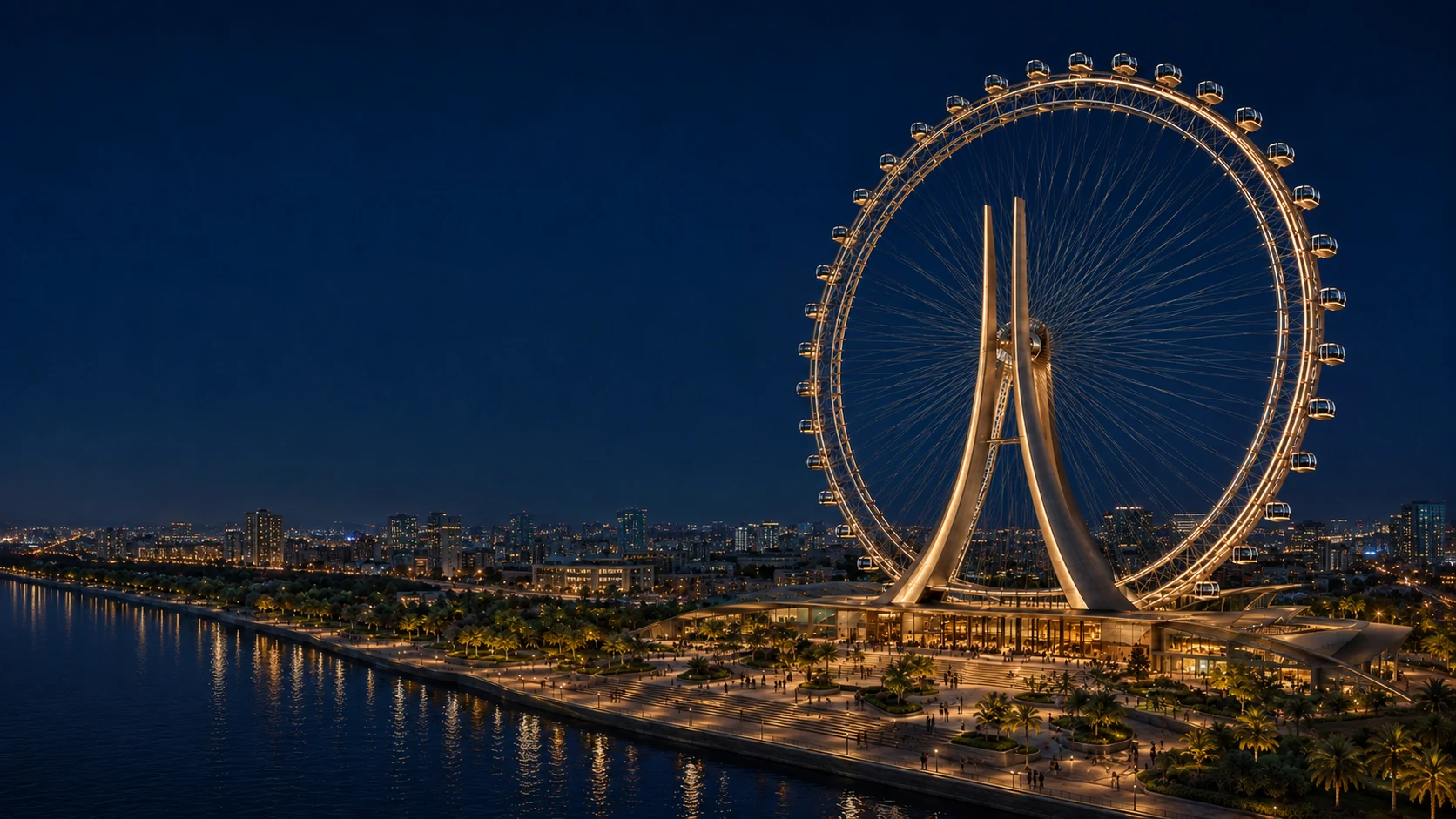
Amaravati Eye concept.Designed for Amaravati.
A proposed landmark observation wheel destination shaped around panoramic capsules, a sculptural twin-pylon identity and a public waterfront experience for Amaravati.
- Status
- Concept
- Experience
- Panoramic capsules
- Setting
- Waterfront destination
Concept visualization
A destination designed at every scale.
Structure, capsules, arrival, landscape and night lighting share one architectural language. Every direction remains subject to site, engineering, environmental, cultural and authority review.
 Concept visualization
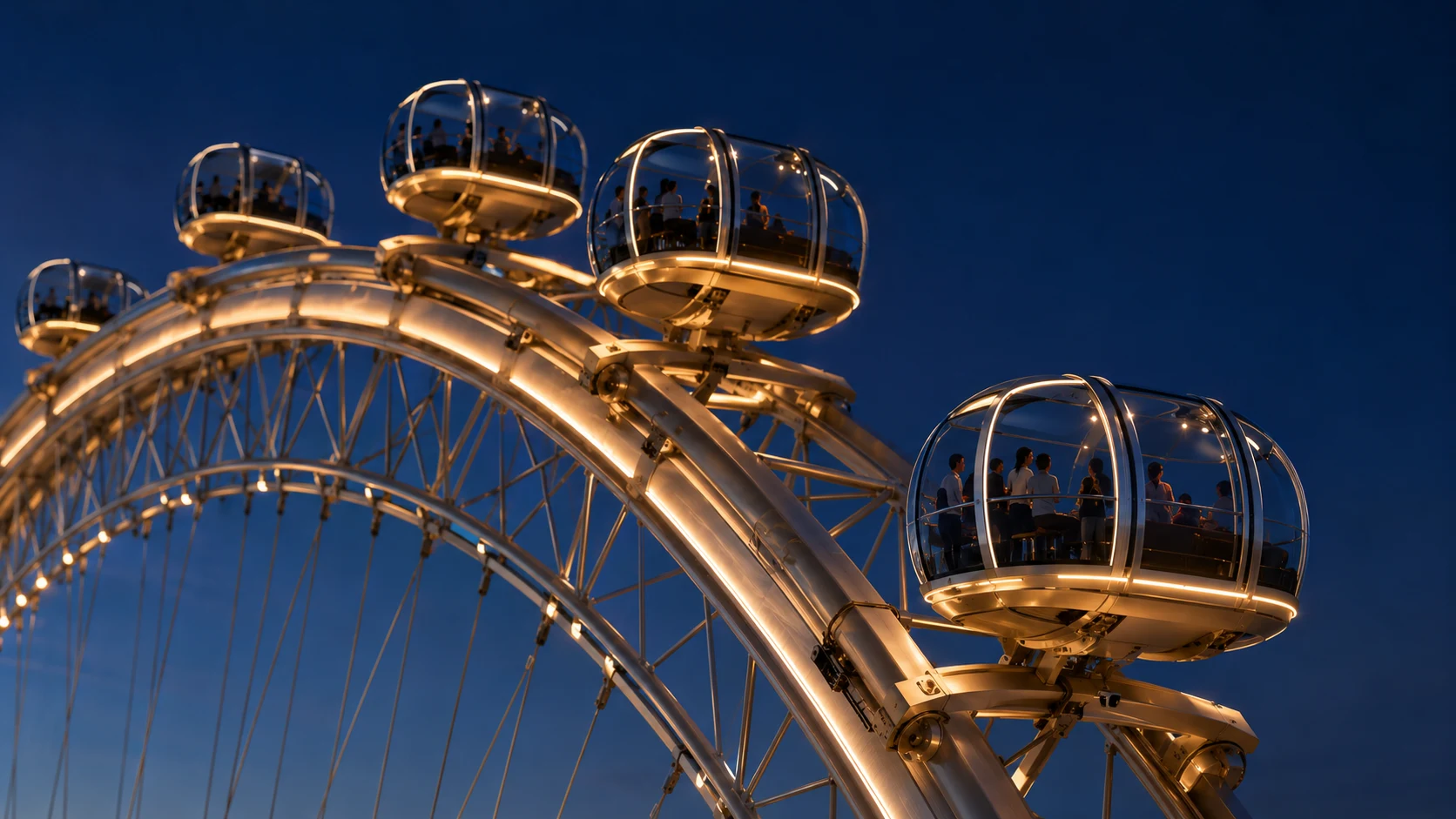
Capsule engineering
Level-riding panoramic capsules combine curved low-iron glass, accessible circulation and discreet mechanical connections.
 Concept visualization
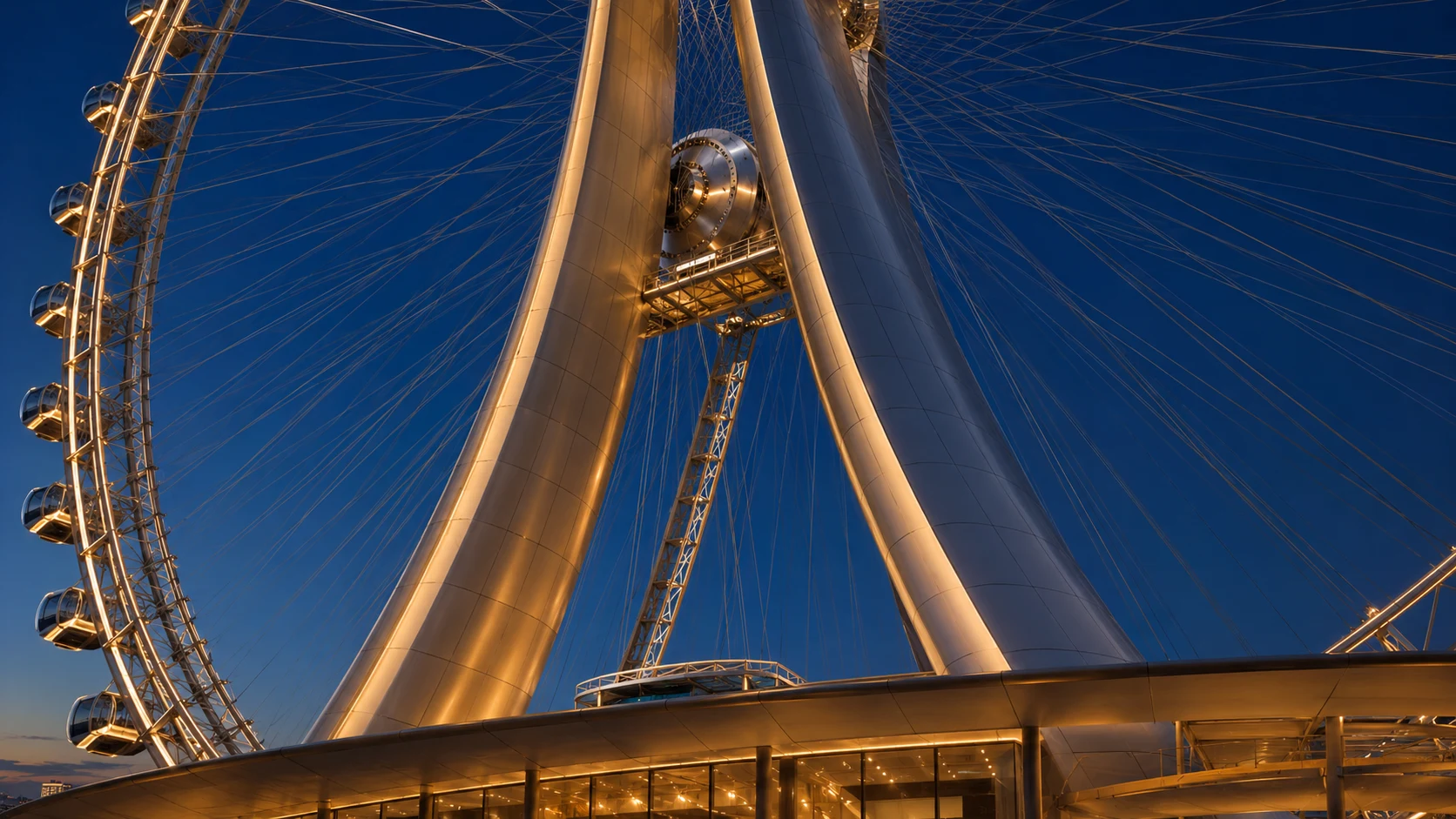
Structural identity
Twin tapering pylons frame the hub and give the wheel a silhouette designed for Amaravati rather than a generic attraction.
 Concept visualization
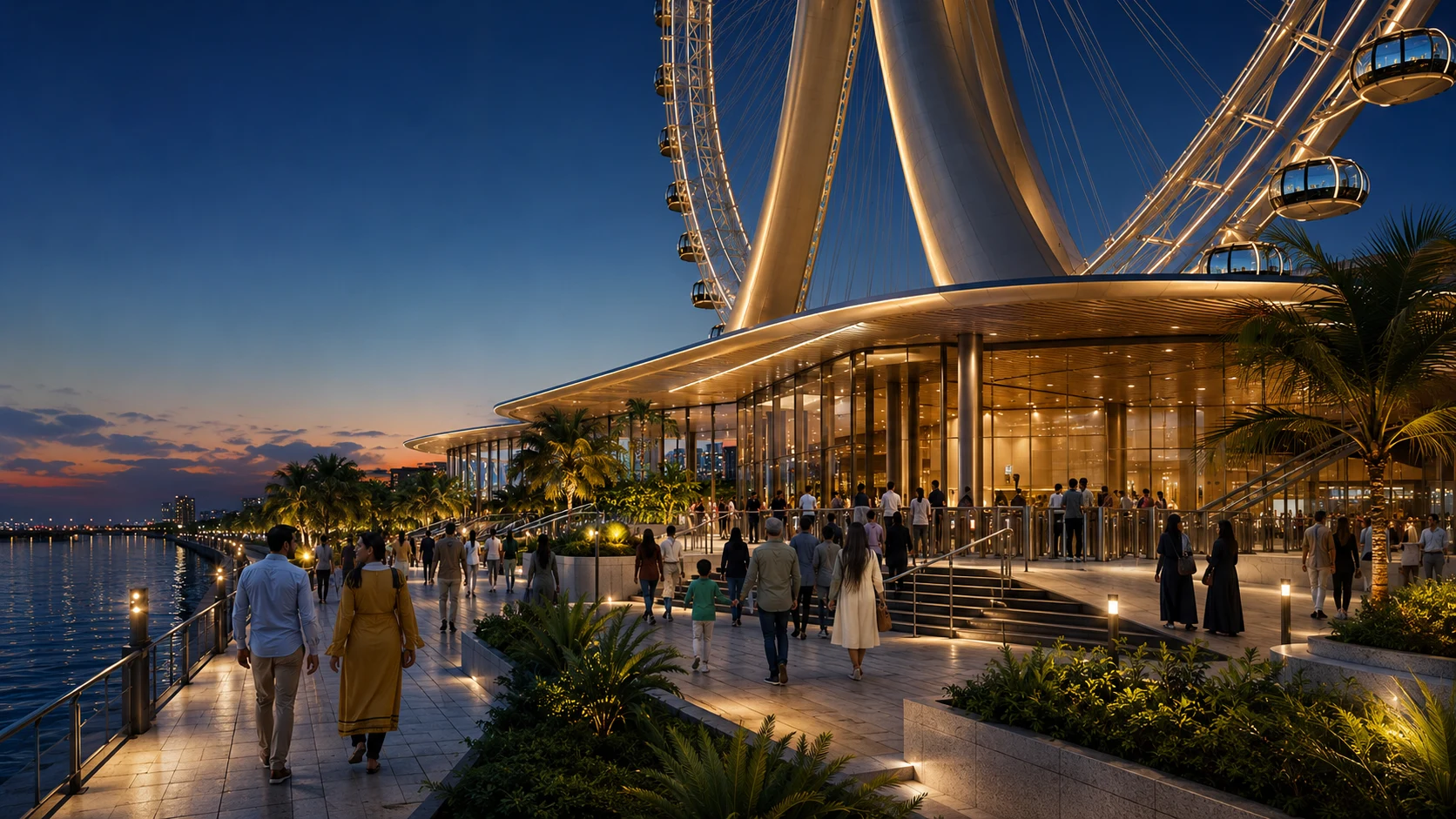
Arrival and boarding
A shaded waterfront pavilion turns boarding into a clear, accessible sequence connected to landscape and public life.
 Concept visualization
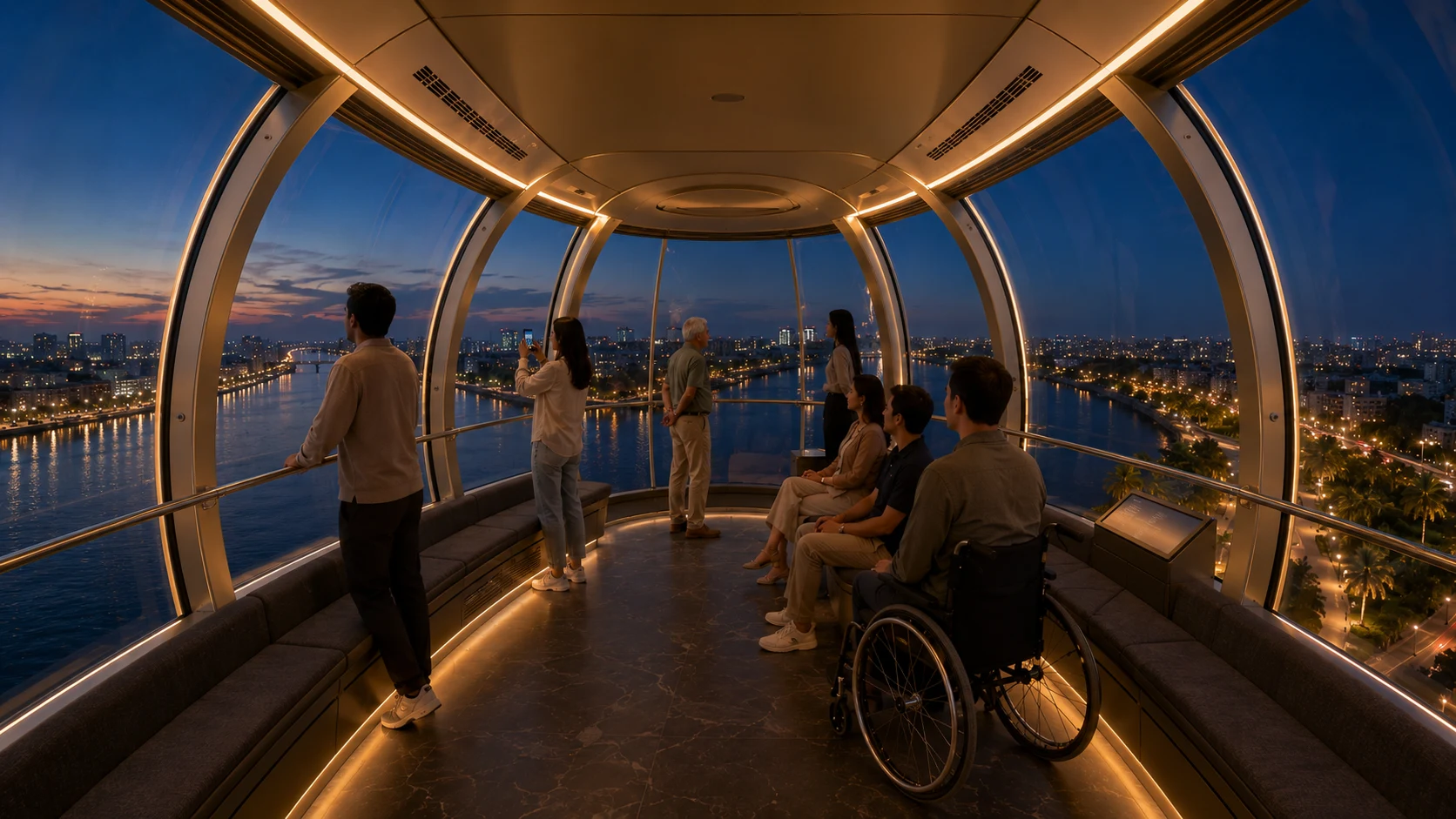
Panoramic interior
Warm, low-glare interiors provide uninterrupted city and river views with space planned for visitors of every ability.
Concept status. Publication rights and architecture, structural and local-cultural reviews remain pending. Last reviewed 2026-08-29.
A landmark wheel is judged by four different audiences at once.
It is read as architecture, procured as infrastructure, financed as a commercial asset and operated as a passenger transport system. Each reading imposes constraints the others do not, and they are resolved together or not at all.
- As architectureIs the silhouette worth building, and does it belong to this city?
- As infrastructureCan it be procured, and does the evidence satisfy an assessor?
- As a commercial assetDo throughput, availability and operating cost make a case?
- As passenger transportIs it safe to board, carry and evacuate, every day, for decades?
- 01
Iconic
It has to be worth building. The silhouette is read from kilometres away, long before anyone buys a ticket.
- 02
Safe
It carries passengers continuously, in the open air, and an independent body has to accept the evidence that it is safe before it opens.
- 03
Buildable
Every component has to be fabricated, transported to site and raised through a sequence of temporary structural states.
- 04
Commercially credible
Throughput, availability and operating cost decide whether the asset works. All three are fixed by engineering decisions.
- 05
Accessible
Boarding, circulation and evacuation have to work for every visitor, not for an average one.
- 06
Locally integrated
It has to be fabricated, erected and maintained by a supply chain that can actually reach the site.
- 07
Maintainable
The inspection regime the operator lives with for thirty years is set during design, whether or not anyone plans it.
One engineering thread, from first feasibility question to year thirty.
The stages are sequential, but the decisions are not. What is settled in feasibility determines what is possible at commissioning, and what is designed in year one sets the maintenance regime for the life of the asset.
Feasibility and business case
Establishing whether a wheel of a given size can be built on a given site, and what it would take.
A landmark wheel is usually proposed before anyone knows whether the site can carry it. Height is chosen for ambition and to offer the visibility required for the specific location, often before ground conditions, wind exposure, access and logistics have been tested. Decisions taken in this period are the most expensive ones on the project, and they are taken with the least information.
- Structural
- Geotechnical
- Wind
- Logistics
- Operations planning
Concept and experience design
Resolving how the wheel is read from the city, and how a visitor moves through it.
A wheel is experienced twice: as a silhouette on the skyline from several kilometres away, and as a twenty-minute journey inside a cabin. These two readings pull in opposite directions. Structural depth that reads as elegant from a distance can obstruct the view from inside it.
- Experience design
- Structural
- Lighting
- Accessibility
- Operations
Engineering and systems
The structural, mechanical, electrical and control engineering that makes the wheel work.
At extreme scale, an observation wheel is a rotating structure carrying passengers continuously, for decades, in the open air. It combines a tension-spoke structure, a slow-speed drive system, a cabin stabilisation mechanism and a safety-related control system. Each is demanding on its own. The difficulty is that they have to be engineered together, because every one of them changes the loads on the others.
- Structural
- Mechanical
- Electrical
- Control systems
- Functional safety
- Fatigue and dynamics
Procurement and local manufacturing integration
Turning a design into fabricable packages, and qualifying who fabricates them.
A wheel is not bought as a product. It is fabricated as several thousand tonnes of steel across multiple suppliers, to tolerances that only matter when the pieces meet on site. Local content requirements make this harder, not easier: qualifying a regional fabricator takes engineering effort long before the first plate is cut.
- Materials and welding
- Quality engineering
- Supply chain
- Structural detailing
Erection and site integration
The engineering of how the wheel is assembled and raised.
Erection is where a wheel project is most often lost. A structure designed for its finished, tensioned condition passes through a series of temporary states that can load it in entirely different directions. The half-built wheel is a different structure from the finished one, and it has to be engineered as such.
- Construction engineering
- Temporary works
- Heavy lift
- Survey
- Site safety
Testing, certification and commissioning
Demonstrating, to an independent party, that the wheel is safe to carry passengers.
A wheel does not open simply because construction is complete. It opens when an independent body accepts the safety evidence. That evidence must be planned from the start because a test that was not designed for cannot be recovered late in the programme.
- Certification
- Functional safety
- Commissioning
- Quality assurance
- Operations
Operations readiness and lifecycle services
Keeping the wheel safe, available and economic for the decades after it opens.
A wheel earns its return over thirty years, not on opening day. Availability is a commercial number: a wheel that is closed is a wheel that is not selling tickets. The maintenance regime, the spares strategy and the inspection intervals are set during design, whether or not anyone thinks about them then.
- Reliability
- Asset management
- Structural inspection
- Operations engineering
Concept visualisation. Not a depiction of a built project
Ain Dubai
Ain Dubai is the world’s tallest observation wheel, rising over 250 metres above Bluewaters Island. Its 48 air-conditioned cabins provide panoramic views across Dubai and accommodate up to 1,750 guests.
- Project type
- Observation Wheel
- Completion
- 2021
- Height
- Over 250 metres
- Cabins
- 48 air-conditioned cabins
- Capacity
- Up to 1,750 people
- Contracting entity
- Hyundai Engineering and Construction
- Partners
- Hyundai Engineering and Construction: Main contractor · Starneth: Specialist observation-wheel design and engineering under subcontract
Eight cities. Eight identities. One national platform.
Starneth India is developing a repeatable platform for landmark observation-wheel destinations, with each city concept evaluated independently and designed around its local culture, landscape and visitor economy.
- 01 / 08Amaravati EyeKrishna River Civic HorizonA river-facing observation wheel shaped as calm civic infrastructure for Andhra Pradesh's capital region.Explore the concept →
- 02 / 08Ahmedabad EyeRiverfront Civic FrameA Sabarmati riverfront wheel carried by twin concrete pylons above a terracotta stepped civic court.Explore the concept →
- 03 / 08Chennai EyeKolam and CoastA cyclone-ready coastal wheel on a three-point tripod beside a long monsoon roof and stormwater promenade.Explore the concept →
- 04 / 08Delhi EyeJaal and AxisA formal Delhi NCR landmark defined by curved four-leg pylons, a winter garden axis and transit access.Explore the concept →
- 05 / 08Goa EyeRiver, Laterite and LightA compact Mandovi waterfront wheel with four low portal legs, rounded cabins and a shaded Goan public square.Explore the concept →
- 06 / 08Kochi EyeNet and TideA backwater wheel carried by two braced portal towers behind a timber and laterite ferry terminal.Explore the concept →
- 07 / 08Mumbai EyeThe Arabian ArcA sea-facing cantilever wheel with a dense urban promenade and a clear Mumbai harbour identity.Explore the concept →
- 08 / 08Varanasi EyeRiver of LightA sunrise river landmark with low wide supports and a Shiva-inspired bronze civic artwork outside the wheel load path.Explore the concept →


Concept directions. No city project is awarded, contracted, financed or approved. Each concept remains subject to independent feasibility, authority approvals and project-specific contracting.
Engineering practice, built for Indian delivery.
Landmark wheels in India are procured through long-concession structures and built through regional supply chains. Both are workable. Both need the technical envelope defined before the commercial one.
Our India practice exists to close the gap between an ambition set in a masterplan and a structure that can actually be fabricated, erected, certified and operated here. That means engaging with the site before the height is fixed, and with the supply chain before the tender is issued.
It also means being precise about who does what. On a wheel at landmark scale, structural design, installation engineering, fabrication and construction execution are usually held by different parties. Naming those boundaries early is the single most effective risk control available to a client.
- Site before heightGround, wind and access decide what diameter is real.
- Packages before tendersFabrication scope written to match supplier capability.
- Interfaces namedEvery boundary assigned before it becomes a dispute.
- Evidence planned earlyCertification designed for, not discovered late.
Load has to reach the ground, and evidence has to reach an assessor.
Two things govern a wheel project. The structural load path, which is a physical fact, and the assurance path, which is a documentary one. Both are designed.
The structural path
Passenger load enters at the cabin and leaves at the foundation. Everything between - rim, spoke, hub, spindle, support leg: is a member in that chain, sized by a case that is usually fatigue rather than peak load, because the structure cycles every operating day for decades.
The assurance path
A wheel opens when an independent body accepts the evidence that it is safe. That evidence is assembled from design calculations, fabrication records, erection verification, functional testing and trial operation. A test nobody designed for is a test that cannot be passed late in the programme, so the certification route is planned during design.
Commercial possibilities
A wheel can carry hospitality, private cabins, events, retail and sponsorship, and anchor a public realm that works when the wheel is closed. These are design decisions with structural consequences, best taken early. What they will return is a matter for the client’s own business case, not ours.
Engineering notes
- EngineeringWhat makes an extreme-scale observation wheel difficultAt extreme size, four demanding engineering problems have to be solved as one, because each changes the answers to the others.7 min
- India marketProcurement readiness for landmark attraction projectsIndian PPP structures are well suited to landmark attractions, provided the technical envelope is defined before the commercial one. Where that order is reversed, the tender is usually re-called.6 min
Dr. Zama M.S.
Founder and Managing Director, Starneth India
Dr. Zama M.S. is the Founder and Managing Director of Starneth India. He leads the company's strategy, partnerships and accountable delivery of landmark observation-wheel projects in India.
Meet the leadership